Background
Bangladesh is the home to the world’s largest active delta at the confluence of the Ganges–Brahmaputra–Meghna river basin (approximately 120400–120500 km²) and one of the planet’s largest floodplains which is ecologically sensitive. Historically, lives and livelihood of the coastal region of Bangladesh have been developed through the optimum utilization of resources from this sensitive ecosystem. The coastal region of Bangladesh stretching along an extensive shoreline by the Bay of Bengal is approximately 710 km (ICZMP) consists of the stable, mangrove-dominated Southwest defined by brackish and saline water, the geologically active and eroding South Central delta shaped by massive river sediment, and the stable Southeast characterized by hilly terrain, sandy beaches, and coral reefs.
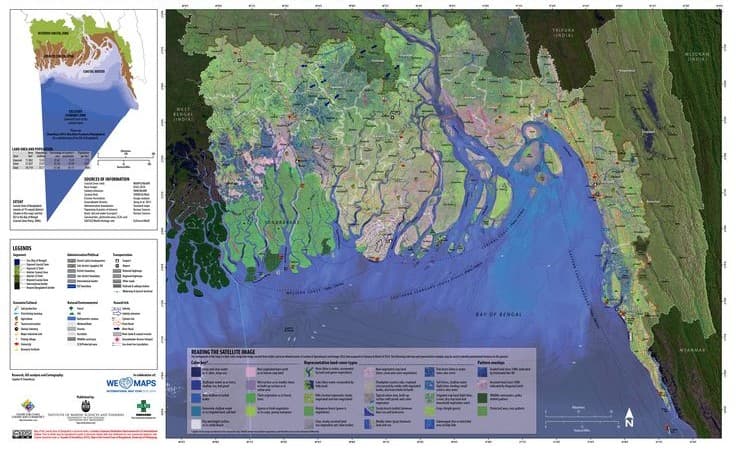
Since the 1950s, human interventions undertaken in the name of development have taken place across Bangladesh’s coastal region without adequately considering the environmental and ecological characteristics of this dynamic landscape. Over time, structural and land-use decisions—implemented without considering environment, ecology, and biodiversity—have contributed to a widening set of interconnected problems affecting water security, ecological balance, ecosystem services, and coastal livelihoods.
According to many geologists, in many coastal pockets, land formation is relatively recent and still geologically dynamic. When interventions outpace natural sedimentation, tidal exchange, and drainage processes, the outcome can be long-term water stress rather than improved resilience. These pressures have accelerated waterlogging, disrupted habitats, degraded biodiversity, and weakened the natural systems that support agriculture, fisheries, and safe living conditions.
At the same time, climate-driven stressors are rapidly compounding these vulnerabilities. Freshwater availability is shrinking while salinity intrusion, pollution, and recurrent climate shocks—cyclones, storm surges, and sea-level rise—are increasing. A visible and consequential process is underway: water patterns are changing, with the freshwater–saline balance shifting inland, dry-season freshwater flows increasingly stressed, and safe water sources becoming scarcer.
Together, these drivers are already reshaping public health outcomes, livelihood viability (agriculture, fisheries, wage labor), ecosystem integrity, and displacement risks—particularly among the poorest and most exposed groups in coastal Bangladesh.
In response, coastal communities are adapting through a mix of locally led, practical measures. While these adaptations show resilience and innovation, they often remain constrained by limited infrastructure, finance, and governance support—highlighting the need for coordinated, ecosystem-sensitive solutions at scale.
Under its strategic plan, An Organization for Socio-Economic Development (AOSED) undertook extensive consultations with stakeholders across levels—including government institutions, CSOs, CBOs, NGOs, academia, and the media—and realized the urgent need for more coordinated, collective action on coastal water challenges.
Building on this realization, and drawing on its engagement with international water platforms such as UN-Water, World Water Week, and the World Water Forum, AOSED as the secretariat initiated a dedicated advocacy and coordination platform and initiated the 1st Coastal Water Convention in 2011.
The first convention brought together 43 organizations, positioning coastal water as a justice and rights issue and reinforcing the principle that water is not a commodity—but a fundamental right. It helped establish a national space where communities, researchers, practitioners, and decision-makers could engage on the distinct water challenges of the coastal belt.
The Khulna Declaration contributed to national policy discourse that influenced the Bangladesh Water Act-2013, helping elevate rights-based framing within water governance conversations.
The 2nd Coastal Water Convention (2019) convened 42 organizations under the theme “Water Justice in Development Progress.” It strengthened the agenda from recognition to governance and action, expanding multi-stakeholder engagement and focusing on governance gaps, equity, ecosystem integrity, and practical pathways for safe water in climate-affected coastal contexts.
The Convention also produced the Khulna Declaration (2019), articulating a structured set of actions for improved governance, responsibility, and resourcing toward safe and equitable water access in coastal Bangladesh.
Momentum beyond the Convention
CWC has not functioned as a one-off event. As the Convention Secretariat, AOSED has sustained national and international engagement to ensure coastal water priorities remain visible and actionable. AOSED has participated in leading global water platforms—including the UN Water Conference, World Water Forum, and World Water Week—contributing through relevant theme and topic processes and ensuring that Bangladesh’s coastal water realities inform wider global dialogues.
AOSED also strengthens advocacy and collaboration through coalition engagement, including membership in the Freshwater Action Network (FAN) and FAN South Asia (FANSA), steering committee membership of the Butterfly Effect Coalition, and engagement with End Water Poverty—reinforcing coordinated civil society action on water justice, equity, and sustainability.
AOSED remains committed to continuing as the Convention Secretariat to maintain continuity, institutional memory, and coordinated stakeholder follow-through, including alignment with SDG-linked initiatives such as the SDG Actions platform under “Water Justice towards Sustainable Development.”
Contribution to SDGs
CWC contributes directly to:
- SDG 6 (Clean Water and Sanitation): advancing equity, water quality, coastal WASH priorities, and ecosystem-sensitive water governance in climate-stressed contexts
- SDG 13 (Climate Action): treating water as a climate frontline and promoting resilience, locally led adaptation, and evidence-to-investment pathways
- SDG 14 (Life Below Water): promoting protection and restoration of coastal and marine ecosystems affected by salinity intrusion, pollution, altered river flows, and climate-driven hazards
- SDG 17 (Partnerships for the Goals): convening government, civil society, academia, communities, media, and development partners to align commitments, reduce duplication, and scale solutions
Objective of the 3rd Coastal Water Convention – 2026
The 3rd Coastal Water Convention (24–26 January 2026, Khulna) will convene as a solution-oriented international platform under the theme:
“Conserve Water Ecosystems towards Sustainable Development.”
Its objective is to translate coastal evidence and lived experience into sustained action by:
- advancing policy and practice recommendations that protect water ecosystems while ensuring rights-based access
- showcasing and scaling locally led, climate-resilient solutions for safe water and livelihoods
- strengthening partnerships to mobilize resources, technical support, and political commitment
- consolidating a long-term learning and coordination mechanism so progress continues beyond the Convention
TThe secretariat and partners will convene the outcomes of the convention in UN Water, World Water Forum, and other relevant international platforms.